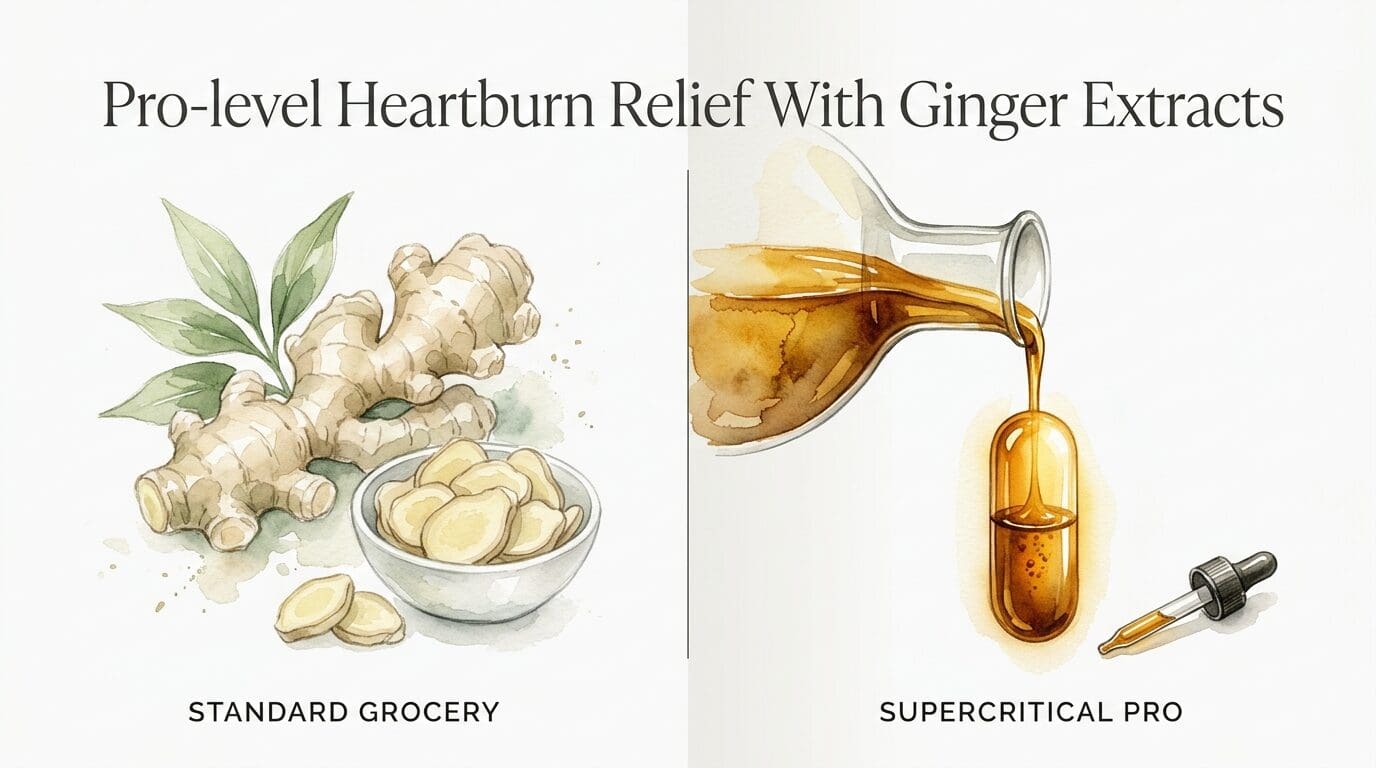
You’d have to eat five pounds of grocery store ginger to get the heartburn-fighting power of this single, professional-grade drop. Not all ginger is created equal. While the stuff in the produce aisle is mostly fiber and water, supercritical CO2 extraction isolates the 6-Gingerol compounds that actually shut down the reflux reflex. This isn’t cooking; it’s precision digestive engineering.
You might have tried chewing on a piece of raw ginger root when your chest felt like it was smoldering. Perhaps you’ve sipped on a ginger ale, hoping the bubbles and the hint of spice would settle the storm. Most people approach ginger as a culinary afterthought, but for those who understand the mechanics of the human gut, it is a potent tool.
Think of your digestive system like a complex series of valves and pumps. When one valve fails or the pressure builds up too high, the system backfires. Standard grocery ginger is like trying to fix a high-pressure steam leak with a piece of twine. It might help for a second, but it lacks the structural integrity to do the job right.
Professional-grade ginger extracts are built differently. They are refined, concentrated, and standardized to ensure that every drop carries the chemical payload necessary to interact with your nervous system and your stomach lining. We are talking about moving beyond home remedies into the realm of functional biology.
Pro-level Heartburn Relief With Ginger Extracts
Pro-level ginger relief is the result of modern extraction technology meeting ancient botanical wisdom. At its core, this approach uses highly concentrated forms of the Zingiber officinale plant to address the root causes of acid reflux and esophageal irritation. Unlike antacids that simply neutralize stomach acid, these extracts focus on the movement and pressure of the entire digestive tract.
In the real world, this is used by people who need reliable results without the side effects of long-term pharmaceutical use. It is used by athletes whose digestion shuts down during heavy exertion, and by professionals who can’t afford to have a burning chest during a high-stakes meeting. It is a tool for the person who wants to fix the engine, not just muffle the noise of the knocking pistons.
Imagine the difference between a bucket of muddy river water and a pressurized fire hose. Both contain water, but only one has the concentration and force to put out a fire. Professional extracts provide that force. They target the transient lower esophageal sphincter relaxations (TLESRs) which are often the true culprit behind the burn.
These extracts are typically found in liquid dropper bottles or high-end capsules. They are characterized by their “gingerol” content. Gingerols are the bioactive compounds responsible for the medicinal properties of the root. When you see a “supercritical extract,” you are looking at a substance that has been stripped of its useless bulk to leave only the heavy-hitting chemicals behind.
How Ginger Extract Regulates Gastric Motility
The primary way a high-grade ginger extract works is through a process called gastric emptying. Most heartburn isn’t caused by having too much acid; it’s caused by acid being in the wrong place at the wrong time. If your stomach is slow to empty its contents into the small intestine, pressure builds. This pressure forces the lower esophageal sphincter (LES) to pop open, allowing acid to splash upward.
Ginger acts as a prokinetic agent. In simple terms, it tells the stomach to get a move on. It stimulates the rhythmic contractions that push food downward. When the stomach empties efficiently, the pressure against the LES drops. A closed valve means no heartburn. It is a mechanical solution to a mechanical problem.
The 6-Gingerol compound also interacts with serotonin receptors in the gut. While we often think of serotonin as a brain chemical, the vast majority of it lives in your digestive system. By modulating these receptors, ginger extract can reduce the sensation of nausea and prevent the “reflux reflex” from triggering in the first place.
Furthermore, these extracts have a direct anti-inflammatory effect on the lining of the esophagus. If you have suffered from chronic reflux, your throat is likely raw and sensitive. The concentrated oils in a professional extract act as a soothing balm, reducing the redness and swelling that make every swallow feel like a chore.
The Benefits of Supercritical CO2 Extraction
You might wonder why you can’t just boil a lot of ginger tea. The answer lies in the chemistry of the plant. Many of the most beneficial compounds in ginger are heat-sensitive. When you boil them, you change their molecular structure, often turning the sharp, effective gingerols into milder shogaols. While shogaols have their own benefits, they don’t always provide the same immediate prokinetic “punch.”
Supercritical CO2 extraction is the gold standard for creating professional-grade extracts. This process uses carbon dioxide at extremely high pressure and low temperatures. At this state, the CO2 acts like a solvent, pulling the essential oils and resins out of the plant material without damaging them.
Purity is the first major benefit. Since CO2 is a gas at room temperature, it simply evaporates once the pressure is released. This leaves behind a pure, potent resin with zero chemical residues. You aren’t consuming the hexane or ethanol often used in cheaper extraction methods.
Potency is the second benefit. This method allows for a much higher concentration of 6-Gingerol. In a standard powder, you might get 1% or 2% actives. In a supercritical extract, that number can climb significantly higher. This means you need a much smaller dose to achieve a therapeutic effect, which is easier on the palate and the wallet in the long run.
Stability is the final piece of the puzzle. Because the oils are extracted without heat, they remain stable for much longer. They won’t go rancid or lose their potency on the shelf. When you take a drop six months after buying it, it still possesses the same “pioneer grit” it had on day one.
Common Mistakes When Using Ginger for Heartburn
One of the most frequent errors people make is using “ginger-flavored” products. Most commercial ginger ales and candies contain almost zero real gingerol. They are loaded with high-fructose corn syrup, which actually relaxes the LES and makes heartburn worse. You are effectively pouring gasoline on a fire while thinking you’re using an extinguisher.
Another mistake is timing the dose incorrectly. If you wait until your chest is already screaming, you are playing catch-up. While a professional extract can provide some immediate relief, it is far more effective when used as a preventative measure. Taking your extract 15 to 20 minutes before a meal prepares the stomach for the incoming load.
Dosage is also a common stumbling block. People often take far too little. Because they are used to the weak flavor of grocery store ginger, they assume a tiny hint of spice is enough. Professional extracts are potent, but you still need a clinically relevant dose to stimulate gastric motility. On the flip side, taking an extreme amount on an empty stomach can cause a temporary “warming” sensation that some mistake for more heartburn.
Finally, people often fail to drink enough water with their extract. Even though the extract is concentrated, your digestive system still needs fluid to move things along. Think of the extract as the lubricant and water as the fuel. You need both for the machine to run smoothly.
Limitations and When to Be Cautious
While ginger is one of the safest botanicals available, it is not a magic wand for every situation. There are realistic constraints you need to understand. For instance, ginger is a known cholagogue, meaning it stimulates bile production. If you have active gallstones, this increased bile flow could potentially trigger a gallbladder attack.
Individuals on blood-thinning medications like Warfarin should also be careful. Ginger has mild anti-platelet properties. In culinary amounts, this is rarely an issue, but at professional-grade concentrations, it can theoretically increase the risk of bruising or bleeding. Always talk to a professional if you are on heavy-duty medication.
Furthermore, ginger extract cannot fix structural issues. If you have a significant hiatal hernia—where a portion of your stomach has physically moved above the diaphragm—no amount of 6-Gingerol will move it back. In these cases, ginger can manage the symptoms, but it won’t solve the underlying anatomical problem.
There is also the “threshold effect.” For a small percentage of the population, very high doses of ginger can cause a temporary relaxation of the LES rather than a tightening. This is rare and usually only happens at extreme doses, but it’s a reminder that more is not always better. Finding your personal “sweet spot” is key to long-term success.
Standard Grocery Ginger vs. Supercritical Pro Extracts
To understand why professional-grade materials matter, we have to look at the numbers. The following table compares the raw characteristics of standard root ginger against a high-quality supercritical extract.
| Feature | Standard Grocery Ginger | Supercritical Pro Extract |
|---|---|---|
| Active Gingerols | Low (0.5% – 2%) | High (25% – 50%+) |
| Fiber/Bulk | High (Mostly cellulose) | None (Pure oil/resin) |
| Absorption Speed | Slow (Must be digested) | Fast (Mucosal absorption) |
| Precision Dosing | Difficult (Root size varies) | Easy (Standardized drops) |
| Shelf Life | Short (Rots/Shrivels) | Long (Stable oils) |
As you can see, the difference is one of efficiency. You can certainly get enough gingerol from the raw root if you eat enough of it, but the sheer volume of fiber and acrid juice you’d have to consume would likely upset your stomach before it helped your heartburn. The professional extract removes the barrier to entry.
Practical Tips for Maximum Relief
To get the most out of your ginger extract, you should treat it like a precision tool. Start by taking your dose in a small amount of room-temperature water. Ice-cold water can actually slow down gastric emptying, which works against what the ginger is trying to achieve.
Try the “Pre-Meal Prime.” Take 5–10 drops of extract 15 minutes before your largest meal of the day. This signals to your digestive enzymes and your stomach muscles that work is coming. By the time the first bite hits your stomach, the “engine” is already warmed up and ready to move the food through.
Combine with healthy fats. Gingerols are fat-soluble. If you take your extract alongside a meal that contains a bit of healthy fat—like avocado, olive oil, or butter—you will likely improve the absorption of the active compounds. This ensures the 6-Gingerol gets into your bloodstream and to your nerve endings more effectively.
Mind your posture. Even the best extract can’t fight gravity perfectly. After taking your ginger and eating your meal, avoid lying flat for at least an hour. Let the ginger do its job of pushing the food down into the small intestine while gravity keeps the acid in the bucket.
Advanced Bioavailability and Digestive Tuning
For those looking to take their digestive health to a deeper level, understanding the “Gingerol-Shogaol Ratio” is vital. When ginger is dried or heated, the gingerols convert to shogaols. Shogaols are actually punchier and hotter on the tongue, and they are excellent for chronic inflammation. However, for immediate heartburn and motility, you want a higher ratio of gingerols.
This is why you should look for extracts that specify “Fresh Ginger” or “CO2 Total Extract.” These processes preserve the gingerol profile. If you find yourself dealing with “silent reflux” (where you don’t feel the burn but have a chronic cough or throat clearing), you might benefit from a blend that includes both ginger and artichoke extract. Artichoke works synergistically with ginger to open the “exit door” of the stomach (the pyloric sphincter).
Another advanced technique is the use of “enteric-coated” ginger capsules. These are designed to bypass the stomach and dissolve in the small intestine. While this isn’t as helpful for immediate heartburn, it is incredible for lower GI issues like bloating and fermentation. If your heartburn is caused by pressure from gas in the small intestine pushing upward, enteric-coated ginger is the solution.
Serious practitioners also monitor their “transit time.” You can do this by eating something distinct (like beets) and seeing how long it takes to pass through your system. If your transit time is longer than 24 hours, your “engine” is idling too slow. Using a professional ginger extract can help tune that engine back to a healthy 12-to-18-hour cycle.
Real-World Scenario: The Holiday Feast
Let’s look at a practical example. Imagine it’s Thanksgiving. You know you’re going to consume a large amount of protein, fats, and carbohydrates. For a chronic heartburn sufferer, this is usually a nightmare that ends with a handful of chalky antacids and a sleepless night.
Instead of waiting for the pain, the pro-level approach involves a three-step protocol:
1. **The Prime:** 10 drops of supercritical ginger extract in 4oz of water 20 minutes before the meal.
2. **The Meal:** Eat slowly, allowing the ginger-stimulated enzymes to work.
3. **The Clean-up:** 5 drops of extract 30 minutes after the meal to ensure the stomach doesn’t “stall” under the heavy load.
In this scenario, the ginger extract acts as a foreman on a construction site, keeping the workers moving and ensuring that no debris builds up. Most people find that by using this method, they don’t even need their usual antacids. Their stomach simply processes the food and moves on.
Another scenario involves the “Midnight Burn.” This is when you wake up at 2 AM with acid in your throat. In this case, a quick dose of liquid ginger extract can provide rapid relief by stimulating the LES to clamp shut and encouraging the stomach to clear whatever leftover debris is causing the irritation.
Final Thoughts
Mastering your digestion requires better tools than what you find in the spice rack. While raw ginger has its place in the kitchen, the precision of a supercritical extract is what’s needed when you’re dealing with the mechanical failure of acid reflux. By focusing on gastric motility and valve pressure, you are addressing the cause of the problem rather than just masking the symptoms.
Taking control of your health is a process of learning the mechanics of your own body. Use these extracts as part of a broader strategy that includes mindful eating, proper hydration, and an understanding of how your internal systems interact. The grit and resilience of the pioneers weren’t just about toughness; they were about knowing how to use the best tools available to get the job done right.
Not all ginger is created equal. While the stuff in the produce aisle is mostly fiber and water, supercritical CO2 extraction isolates the 6-Gingerol compounds that actually shut down the reflux reflex. This isn’t cooking; it’s precision digestive engineering. Experiment with these professional extracts, find your rhythm, and stop letting the burn dictate your life.