Introduction: The End of the Bland Diet Era
Why are you starving yourself on a ‘bland diet’ when a single piece of precision data could tell you exactly which herb stops your fire? For decades, the standard advice for heartburn sufferers has been a list of “don’t eat” foods that looks more like a punishment than a nutritional plan. We were told to abandon coffee, spice, and everything that makes a meal worth eating, all based on a generalized guess of what might be causing the burn.
In 2026, we don’t guess which foods cause heartburn. We use precision pH-sensing and targeted Plantain Leaf infusions to treat the exact moment of irritation. No more ‘safe’ foods—just a smart, responsive system that knows what your body needs before the burn starts. This shift from broad guesswork to precision data represents a frontier in gut health that mirrors the grit and self-reliance of pioneers, but with the power of modern technology.
This approach moves us away from the “one-size-fits-all” mentality and into an era where you are the master of your own biology. Heartburn is not a life sentence; it is a signal. When you learn to decode that signal with accurate data and respond with the right biological tools, the “bland diet” becomes a relic of the past. Let’s look at how you can claim this level of control over your own digestive system.
How To Find Your Exact Heartburn Triggers
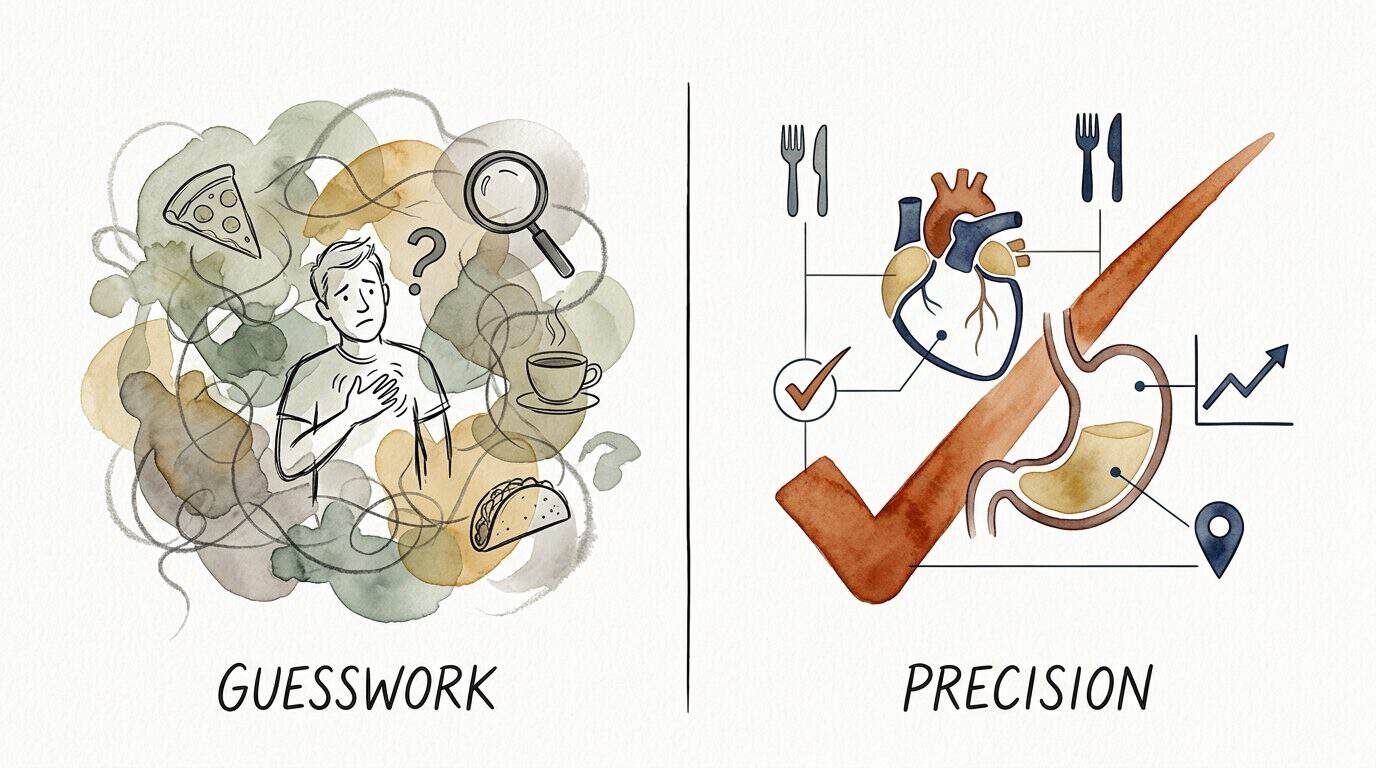
Finding your exact heartburn triggers is the process of identifying the specific chemical, mechanical, or emotional events that cause your lower esophageal sphincter (LES) to fail or your gastric acid to back up. In the old world, this meant keeping a paper diary and hoping you noticed a pattern between the pizza you ate and the fire in your chest three hours later. Today, it involves identifying the delta between your baseline pH and the spikes that occur after specific exposures.
The reality is that “triggers” are rarely universal. While one person might experience immediate reflux from a slice of lemon, another might find that citrus actually aids their digestion by stimulating proper acid production. This paradox exists because heartburn is often a symptom of two very different conditions: too much acid or too little acid. Without precision data, you are essentially shooting in the dark, treating every fire as if it were fueled by the same wood.
In real-world situations, triggers can be highly contextual. A cup of coffee on an empty stomach might cause a massive pH drop, while that same coffee consumed after a protein-rich breakfast might have no effect at all. Finding your triggers means looking at the timing, the combinations, and the physiological state of your body when the symptoms arise. It is about mapping your internal landscape with the accuracy of a surveyor.
Understanding these triggers requires a shift in perspective. You are not looking for a list of “bad” foods; you are looking for “incompatible” moments. This distinction is vital. It allows you to move away from fear-based eating and toward a data-driven lifestyle where you know exactly when you can indulge and when you need to provide your esophagus with extra protection.
The Mechanism of Precision Relief: How It Works
The modern system of heartburn management operates on a feedback loop of sensing and responding. It begins with pH-sensing technology—often in the form of a small, wearable sensor or a temporary internal capsule—that monitors the acidity levels in your esophagus in real-time. This sensor transmits data to a device that maps the acidity levels against your daily activities, such as eating, lying down, or exercising.
When the data shows a significant drop in pH (meaning acidity is rising), the system identifies the moment of irritation. This is where the Plantain Leaf (Plantago major) comes into play. Unlike chemical antacids that simply neutralize acid or PPIs that shut down acid production entirely, Plantain Leaf works through “mucilage.” This is a thick, gluey substance produced by the plant that provides a physical protective layer over the esophageal lining.
The process of using Plantain Leaf as a precision tool involves creating a concentrated infusion. When you ingest this infusion at the precise moment the data indicates a trigger event, the mucilage coats the irritated tissue. This prevents the acid from making contact with the raw or inflamed cells of the esophagus, allowing the body to heal itself while maintaining the necessary acid levels for digestion in the stomach.
This dual approach—sensing the burn and coating the tissue—allows for a surgical level of intervention. Instead of medicating your entire body for 24 hours to prevent a 15-minute window of reflux, you are applying a biological shield exactly when and where it is needed. It is a system built on efficiency and respect for the body’s natural digestive processes.
Benefits of the Precision Approach
The primary benefit of moving from guesswork to precision is the restoration of dietary freedom. When you know for a fact that your “heartburn” is actually caused by a specific type of vegetable oil and not the spice in your tacos, you can reclaim your favorite meals. This psychological relief is often just as important as the physical relief, as it reduces the stress and anxiety associated with eating.
Another major advantage is the preservation of stomach acid. Standard treatments like proton pump inhibitors (PPIs) are often used for years, leading to nutrient deficiencies and weakened digestion because they stop acid production globally. Precision use of Plantain Leaf and pH data allows you to keep your stomach acid—which you need for absorbing B12, calcium, and magnesium—while still protecting your esophagus from damage.
Furthermore, this approach fosters long-term mucosal healing. Constant “guessing” leads to repeated injury to the esophageal lining. By using targeted infusions at the exact moment of risk, you give the delicate tissues the quiet time they need to repair. This can lead to a significant reduction in the frequency of episodes over time, as the “fire” is no longer hitting an already raw surface.
- Individualized Insight: You gain a deep understanding of your own unique biology.
- Nutritional Integrity: You avoid the side effects of long-term acid suppression.
- Cost Efficiency: You spend less on generic “relief” and more on targeted wellness.
- Reduced Inflammation: Plantain Leaf contains aucubin and catalpol, which have natural anti-inflammatory properties.
Challenges and Common Mistakes
One of the most frequent errors in this journey is the “lazy data” trap. People often start tracking their symptoms but fail to track the context. If you note that you had heartburn at 4:00 PM, but you don’t note that you were hunched over a laptop for three hours prior, you might miss a mechanical trigger. Posture and physical compression of the stomach are just as important as the food itself.
Another challenge is the quality of the botanical tools. Not all Plantain Leaf is created equal. Using old, dusty tea bags from a grocery store shelf will not provide the mucilage levels required to coat the esophagus effectively. Practitioners often fail because they are using sub-potent materials. Precision data requires precision ingredients; you need high-quality, organic dried leaves or fresh plants to get the necessary biological response.
Many people also struggle with the “immediate gratification” mindset. While a Plantain Leaf infusion provides immediate soothing, the goal of precision data is long-term management. It takes time to collect enough data points to see the true patterns. If you give up after three days because you haven’t “solved” your reflux, you are missing the forest for the trees. This is a practice of persistence, much like tilling a field.
Finally, there is the mistake of ignoring “silent reflux.” Sometimes the pH data might show a drop even when you don’t feel a burn. Ignoring these data points because you “feel fine” can lead to long-term tissue damage. The goal of precision sensing is to catch the irritation before it reaches the threshold of pain.
Limitations: When Precision Isn’t Enough
It is important to acknowledge that some cases of heartburn are beyond the scope of dietary triggers and herbal infusions. If there is a significant mechanical failure, such as a large hiatal hernia, the stomach has physically moved into the chest cavity. In these instances, no amount of Plantain Leaf or data will fully resolve the issue, and surgical intervention may be necessary.
Environmental factors can also create “noise” that makes data interpretation difficult. For example, extreme chronic stress can lead to “hypersensitive esophagus,” where the pH levels are actually normal, but the nerves in the esophagus are so sensitized that they perceive even normal acid levels as a burn. In this scenario, the precision data will show no “trigger,” which can be frustrating if you aren’t looking at the neurological side of the equation.
There are also limitations based on life stages. Pregnancy, for instance, introduces mechanical and hormonal shifts that can override your usual triggers. During the third trimester, the physical pressure of the growing baby often makes “precision” difficult because the triggers become constant. In these cases, the focus shifts from data-driven avoidance to constant symptomatic protection.
GUESSWORK vs. PRECISION: A Comparison
To understand the value of this modern approach, we must compare the traditional methods against the data-driven model. The differences are not just in the tools used, but in the underlying philosophy of health.
| Feature | Guesswork (Old Guard) | Precision (Modern Frontier) |
|---|---|---|
| Primary Method | Broad Elimination Diets | pH Sensing & Data Mapping |
| Food Philosophy | “Avoid these 50 foods forever.” | “Eat anything that doesn’t trigger a pH drop.” |
| Treatment Tool | General Antacids / PPIs | Targeted Plantain Infusions |
| Long-term Impact | Nutrient Malabsorption | Mucosal Healing & Strength |
| User Role | Passive Patient | Active Data Analyst |
The transition from the left column to the right column is where the real healing happens. It requires more effort initially, as you must learn to read the data and prepare your infusions, but the long-term efficiency and health outcomes are vastly superior.
Practical Tips for Implementation
If you are ready to start using precision data and Plantain Leaf, begin by focusing on the “Cold Infusion” method. Plantain’s mucilage is best extracted with cold or lukewarm water rather than boiling water. Steep two tablespoons of dried Plantain Leaf in a cup of room-temperature water for at least four hours (or overnight). This creates a thick, soothing liquid that is far more effective for heartburn than a standard hot tea.
When tracking your data, make sure to include “Lag Time.” Reflux doesn’t always happen the moment you swallow. It often occurs 60 to 90 minutes later as the stomach enters the peak of its digestive cycle. If your sensor shows a pH drop at 2:00 PM, look back at what you did at 12:30 PM. This lag time is where the most valuable secrets of your digestion are hidden.
Optimize your environment to support the data. If you are testing a specific food, try to do it in a “clean” environment. Don’t test a new spicy dish while also drinking alcohol and sitting in a slouched position. This muddies the data. Isolate variables whenever possible to get a clear picture of how your body reacts to specific substances.
- Batch Brew: Make your cold Plantain infusion in large batches and keep it in the fridge for up to 48 hours.
- Posture Check: Use a sensor to see how much your pH levels improve simply by standing up or using a wedge pillow.
- Hydration Timing: Note if drinking water during meals dilutes your acid too much, causing the LES to stay open longer.
Advanced Considerations for the Serious Practitioner
For those who want to go deeper, consider the role of the esophageal microbiome. Emerging research suggests that the types of bacteria living in your esophagus can influence how sensitive you are to acid. Chronic use of antacids can alter this microbiome, making you more prone to inflammation. Precision use of Plantain Leaf helps maintain a healthier environment for these beneficial bacteria by avoiding the harsh chemical shifts of PPIs.
Scaling this system involves looking at “Stacking Triggers.” Often, a single food isn’t the problem, but a combination of three or four factors. You might be able to handle coffee fine, and you might be able to handle stress fine, but coffee *and* stress *and* a tight belt might be the specific combination that causes a failure. Serious practitioners use their data to identify these “perfect storms.”
Think about the “circadian rhythm” of your stomach acid. Your body naturally produces more acid at certain times of the day. By mapping your pH over a full 24-hour cycle, you might find that your “triggers” only cause issues in the evening when your body’s natural defenses are lower. This allows you to be even more surgical with your infusions, focusing your protection on your vulnerable windows.
The Role of Bitters in Precision Health
While Plantain Leaf provides the shield, “digestive bitters” can sometimes provide the cure. If your data shows that your heartburn is actually caused by *low* acid (which causes food to ferment and push gas/acid upward), then using a bitter herb like Gentian or Dandelion root 15 minutes before a meal can stimulate the LES to close tightly. This is the opposite of the Plantain strategy, but for many, it is the missing piece of the puzzle discovered through data.
Example Scenario: The Coffee Dilemma
Consider the case of a man we will call Elias. For years, Elias believed coffee was his primary trigger. Every time he drank it, he felt a burn. He switched to decaf, then to tea, and finally gave it up entirely, but the burn remained. He was living on a “bland” diet of oatmeal and steamed chicken, yet he was still miserable.
When Elias began using precision pH-sensing, he discovered something shocking. His coffee wasn’t the trigger. His pH stayed stable for the first 30 minutes after his morning cup. The “drop” occurred when he sat down at his desk and began hunching over his keyboard while answering stressful emails. The mechanical pressure of his posture combined with the cortisol spike of stress was causing the reflux.
Armed with this data, Elias changed his routine. He kept his coffee but started drinking it while standing or walking. He also began taking a small “shield” of Plantain Leaf infusion right before he started his morning emails. Within two weeks, his esophageal inflammation had subsided, and he was able to return to a full, varied diet. The data didn’t just give him his coffee back; it gave him his life back.
This scenario highlights the “Precision over Guesswork” philosophy. Without the data, Elias would have continued to blame the wrong culprit while his true trigger—stress-induced mechanical failure—went unaddressed. This is the power of the smart, responsive system we are building in 2026.
Final Thoughts
The era of the “bland diet” is a relic of a time when we lacked the tools to see inside our own bodies. We no longer have to live in fear of the foods we love or rely on broad-spectrum medications that disrupt our internal chemistry. By combining the precision of modern pH-sensing with the ancestral wisdom of Plantain Leaf, we can create a sophisticated, responsive system of health that honors our individual biology.
True gut health is not found in a list of prohibited foods; it is found in the grit to track your own data and the wisdom to use the right biological tools at the right time. It is about becoming the pioneer of your own internal frontier. When you stop guessing and start sensing, the “fire” no longer controls your life. You become the one who decides when and how to extinguish it.
Experiment with these methods. Start with a simple cold-steeped Plantain infusion and begin paying closer attention to the timing of your symptoms. Whether you use a high-tech sensor or a dedicated journal, the goal is the same: clarity. Once you have clarity, you have the power to heal. The frontier of your health is waiting—go out and claim it.